
🚀 From 290 to 320+: A Breakdown of What Worked (GRE Success Story)


A Real GRE Score Transformation Story
When I took my very first GRE diagnostic test, I scored 290.
- Verbal: 140
- Quant: 150
- AWA: 2.5
I was discouraged. I thought maybe I just wasn’t “a GRE person.”
But just 10 weeks later, I walked out of the testing center with a 324.
- Verbal: 157
- Quant: 167
- AWA: 4.5
This isn’t a story about “natural talent.” It’s a story about the right plan, tools, mindset, and habits — and how anyone, no matter their starting point, can do the same.
In this guide, I’ll break down step-by-step what worked for me so you can replicate the same process and dramatically improve your score too. And if you want expert structure and support throughout the journey.
🎯 Step 1: Diagnosing the Real Problem
That first 290 told me more than just a number. It showed me exactly where I was weak and why:
- I was guessing too much on Verbal.
- I wasn’t “bad” at math — just sloppy with details.
- I panicked under time pressure.
- I had no clear structure for the Analytical Writing section.
📌 I didn’t need to become a genius — I needed a plan.
The first step in your GRE journey is the same: take a diagnostic test. Not to judge yourself, but to collect data. You can’t fix what you don’t understand.
🔗 Take your own GRE diagnostic test here to identify your starting point and map out your next steps.
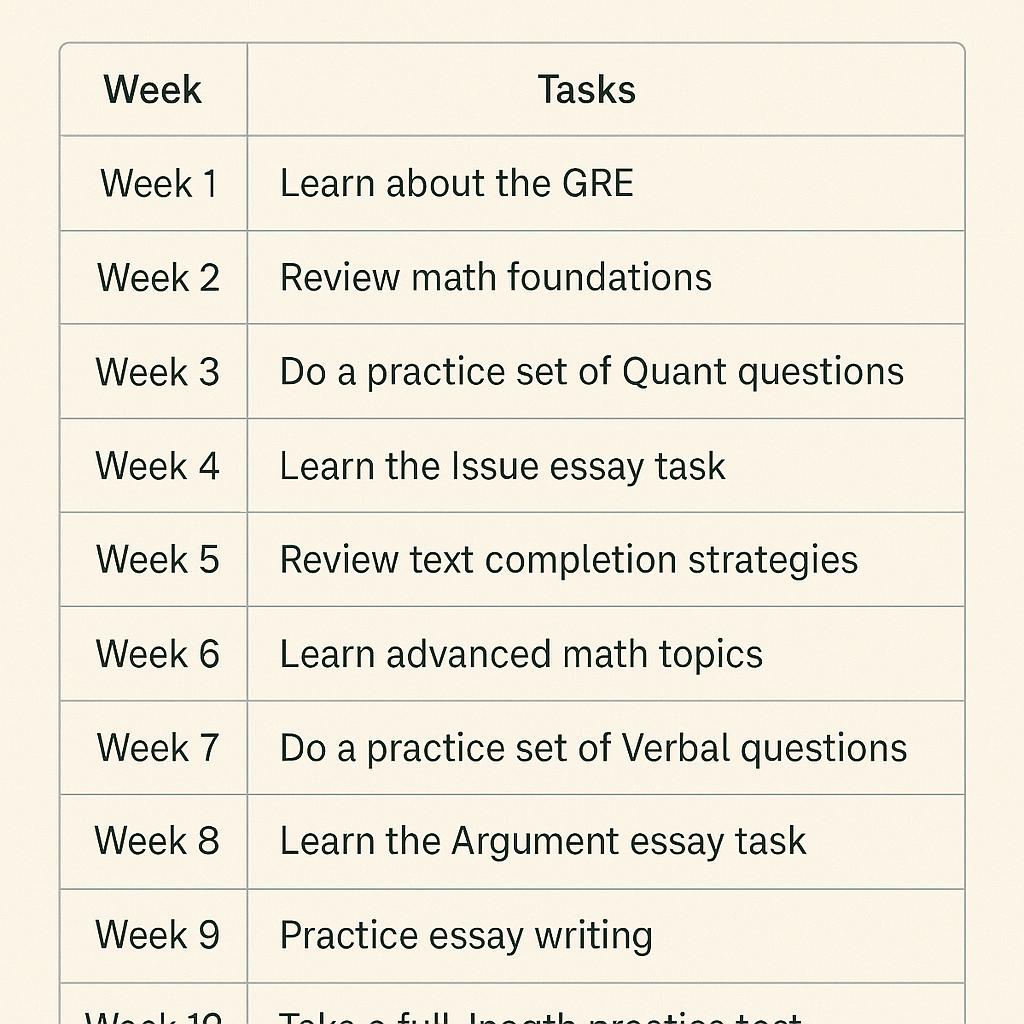
📅 Step 2: Building a 10-Week Study Plan I Could Actually Follow
Here’s the truth: I had a full-time job. Studying five hours a day wasn’t realistic.
So instead of an unrealistic plan I’d abandon in a week, I built one I could stick to for 10 weeks:
- 📘 1 hour per weekday
- 📚 2–3 hours on weekends
- 🧪 1 full-length practice test every other Saturday
A typical week looked like this:
- Monday: Vocabulary + Verbal drills (1 hour)
- Tuesday: Quant problem sets (1 hour)
- Wednesday: Analytical Writing practice (45 min essay + 15 min review)
- Thursday: Mixed timed sections (Verbal + Quant, 1 hour)
- Friday: Error log review + light vocab (30–45 min)
- Saturday: Full-length practice test (once every two weeks)
- Sunday: Review + rest
📌 The plan was flexible — if I missed a day, I didn’t panic. I just adjusted the following week. Consistency, not perfection, was the goal.
📚 Step 3: The Tools That Actually Helped
I tried a lot of resources at first. Most were unnecessary. These were the ones that truly moved the needle:
- 🎓 American School Online GRE Program — for structured lessons, tracking, and feedback.
- 📱 Quizlet — for daily vocabulary (10 words per day).
- ✍️ Writefull — for polishing essays and receiving instant writing feedback.
- 🧮 Photomath + Galvanize — for step-by-step Quant explanations.
- 📊 Google Sheets — for tracking errors, performance, and trends.
🎯 Tip: You don’t need a million tools. You need a few that work well together — and you need to use them consistently.
✍️ Step 4: How I Improved My AWA Score from 2.5 to 4.5
At first, I approached the Analytical Writing Assessment (AWA) with zero strategy. I would just write and hope for the best. That changed quickly when I adopted a structured approach:
- 🧠 I memorized one strong essay template for each task type (Issue and Argument).
- ⏱️ I practiced 2 essays per week under timed conditions.
- 📚 I reviewed official 6.0-level sample essays from ETS to understand what “excellent” looks like.
- 🧑💻 I used Writefull to get instant AI feedback and rewrote weak essays until they improved.
💡 My biggest lesson: Focus on clarity and logical argumentation — not on fancy vocabulary.
📊 Step 5: The Power of the Error Log
This was the single most transformative part of my prep.
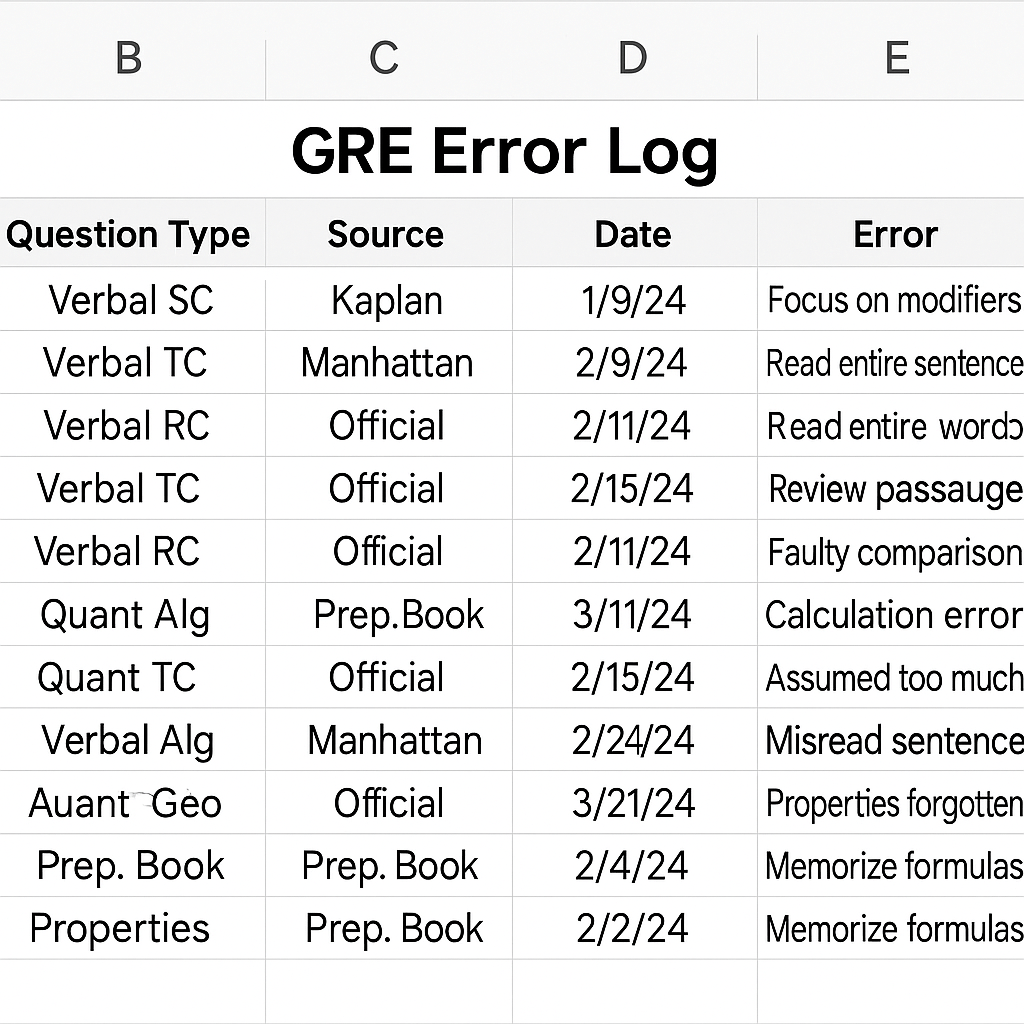
After every practice quiz or test, I logged:
- 📌 The topic (e.g., sentence equivalence, probability)
- 🧠 The mistake type (timing, misread, careless, lack of knowledge)
- 📘 What I learned
- 🔁 A rewritten version of the problem to solve again later
After 3 weeks, I noticed clear patterns.
After 6 weeks, my weak areas became strengths.
Tracking your mistakes turns random studying into targeted improvement. And by the end, I had a personalized “playbook” of errors I’d already solved once — so I was unlikely to repeat them.
🧠 Step 6: My Mindset Shift (The Most Important Change)
At the beginning, I believed:
“I’m just not good at standardized tests.”
That mindset was holding me back. Here’s what changed:
- I stopped expecting perfection.
- I focused on progress, not just results.
- I stopped comparing myself to others.
- I treated the GRE as a game of strategy, not a judgment of intelligence.
Once I shifted my mindset, studying became less about fear and more about solving a puzzle. That change alone boosted my confidence — and my scores.
📝 My Final Week Strategy Before Test Day
The week before the real exam, I focused on refinement, not cramming:
- Monday: Full Quant section + detailed review
- Tuesday: Verbal + vocabulary flashcards
- Wednesday: Essay practice (1 timed, 1 untimed)
- Thursday: Full-length mock test (same start time as real exam)
- Friday: Rest + error log review
- Saturday: Light review + positive mindset exercises
- Sunday: Test day ✅
No all-nighters. No panic. Just calm, deliberate preparation.
Lorem ipsum dolor sit amet, consectetur adipiscing elit. Ut elit tellus, luctus nec ullamcorper mattis, pulvinar dapibus leo.
🎓 How American School Online Helped Me Go from 290 to 320+
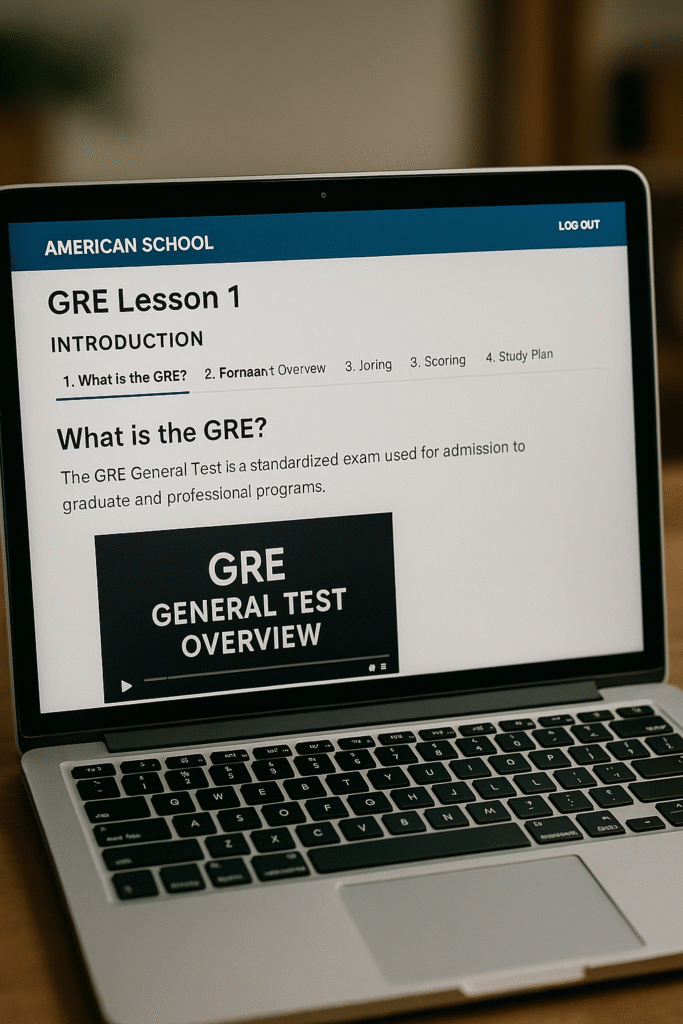
The American School GRE program was the backbone of my prep. It gave me structure, feedback, and accountability — all of which are crucial for big score improvements.
Here’s what made the difference:
- 🗺️ A clear 10-week plan with zero guesswork.
- ⏱️ Timed quizzes that mirrored the real GRE.
- 📊 Visual progress tracking that showed growth over time.
- 📲 Mobile flashcards I used during commutes.
- 👨🏫 Real instructors I could message when stuck.
I stopped wasting time figuring out how to study and focused all my energy on doing it — and that’s what pushed me from 290 to 320+.

Author: faraz_sa33d
Instractor






Responses