
GMAT Data Insights pacing: how to split the 45 minutes


American School · Online prep · GMAT Data Insights
In short: check the clock after every group of five questions, answer before you move on, and keep some time to review with a clear purpose. A pacing card and two worked cases will help you choose what to adjust in your next practice.
You finish Data Insights question 10 and the clock shows 21 minutes. Ten questions to go. On an earlier question you spent too long working out whether to divide by a column total or a row total. Do the same in the next block and you may never see the last questions. Speed up on everything and you may throw away points by reading too fast.
A checkpoint at question 10 lets you make a smaller decision: cut the time you spend without a clear next step, and keep the time you need for steps you know how to do. This guide shows how to practise that adjustment, check whether you reach the end with every question answered, and prioritise reviews that come with a concrete check.
What the Data Insights clock allows
Data Insights has 20 questions and 45 minutes. The section clock includes any time you spend reviewing. You can bookmark a question as you go. The review screen opens after you have answered all 20, if time remains; there you can revisit questions and change up to three answers. If the clock runs out before you reach the review, the section ends. (Source: GMAC, GMAT exam structure and Question Review & Edit.)
On your first pass, choose an answer on the best evidence you have before moving on. A bookmark gives you a way back if you reach the end with time to spare. Finishing the section matters: GMAC states that your score is penalised according to the number of unanswered questions. If you have to choose between finishing your first pass and keeping a fixed number of minutes for review, answer the remaining questions first. (Source: GMAC, scoring and the penalty for unanswered questions.)
The GMAT is adaptive, and the questions you see can change from one official practice test to the next. What you can measure is how you spread your time and what kind of decision you make under pressure. To compare your scores, note whether you used an official practice section or a fixed block, and whether both sessions had similar difficulty and conditions. (Source: GMAC, what to expect on test day.)
A pacing card for the 45 minutes
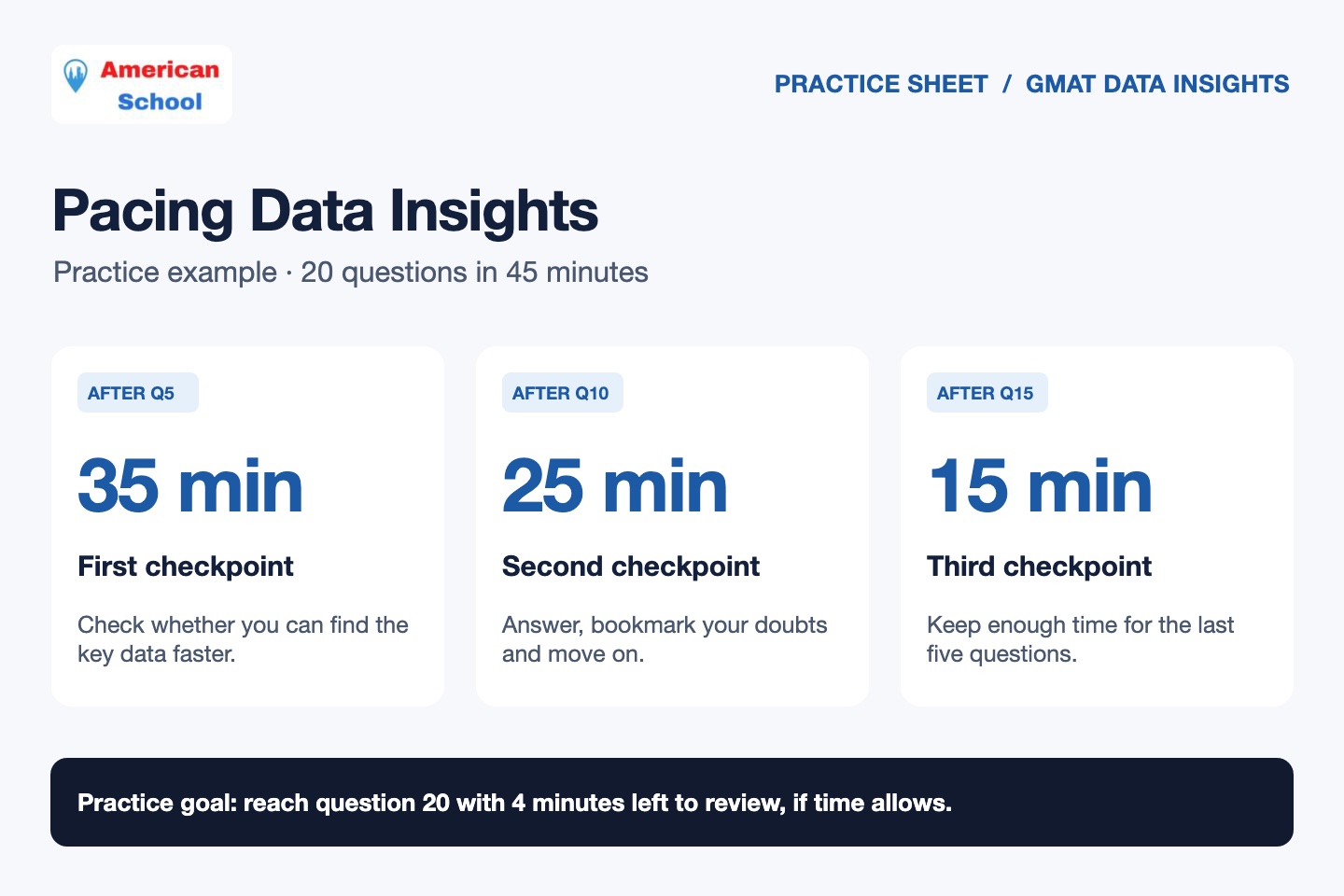
45 minutes divided by 20 questions is 2 minutes 15 seconds on average, which leaves the whole section for a single pass. To try a four-minute review, you have 41 minutes to answer all 20: just over two minutes per question on average. Use it as a group target. A question you can solve in one minute frees time for another where you know what to do but need several steps.
Target time remaining after each group of five questions.
| After answering | Time used | Time left | What to check |
|---|---|---|---|
| Question 5 | 10 min | 35 min | Did I lose time hunting for data without knowing what I needed? |
| Question 10 | 20 min | 25 min | If I’m behind, which kind of block can I cut sooner? |
| Question 15 | 30 min | 15 min | How much can I spend on the last five? |
| Question 20 | 41 min | 4 min | Which answer can I review with a clear check? |
If you have 21 minutes instead of 25 after question 10, you still have ten questions to answer. Insisting on four minutes of review leaves 17 for the first pass on that half. Accepting a shorter review gives you back time for questions you haven’t read yet. Decide when you see the clock, and revisit the decision at question 15. The four-minute budget is a practice target, and it can give way so that you finish the section.
If you reach question 15 with 17 minutes left, protect the advantage. You can use it to finish a calculation you have already set up on a demanding question, or to leave a little more time for review. Spending all your spare time on the first hard question you meet can put you back in the same spot two questions later.
At each checkpoint: see how much time is left, how many questions remain, and which block has cost you the most time so far. Choose one behaviour for the next group, for example moving on as soon as you find yourself looking for the same number again without a clear question in mind.
How to decide whether to stay on a question
Start by stating what data you need and which step would let you check it: “I need to compare two rates with the same base”, or “I want to know whether the axis is in thousands”. That sentence tells you where to look. When the next step exists and is short, finish it if the clock allows.
Imagine a table with two branches. One processes 18 returns out of 120 orders; the other, 24 out of 200. If the question asks for the higher return rate, you know what to calculate: 15% for the first and 12% for the second. The 24 in the second row is the bigger count, but the smaller proportion. Here a concrete check moves you towards the answer and can be worth a few extra seconds. (The example is invented, for practising the timing decision.)
Now imagine you’ve opened two data views, changed the filter and come back to the same table without working out which period the question asks about. Go back to the question once to find that period. If you still have no useful lead and time is tight, choose the best-supported option, bookmark it and move on. The bookmark helps if you can tie it to “comparison period” and check it later. If you don’t know what you’d do when you came back, give it lower priority in your review.
At home, write down what slowed you in one word or a short phrase. “Units”, “denominator” and “wrong column” describe an obstacle you can spot in another exercise; “it was hard” makes you rebuild everything. If the same cause keeps appearing, build a short block to practise that step before going back to the 45-minute timer.
Two cases for adjusting the first pass and the review
Álvaro loses time before question 10
In a practice block, Álvaro answers question 10 with 20 minutes left. Afterwards he sees that a single question took almost four minutes: he tried several operations and none let him eliminate an answer. In the final stretch he leaves two questions blank. His last five give him one correct, two wrong and two blank. When he checks, he finds he could have solved one of the blanks with a direct comparison.
In his second session he uses a similar new block. His adjustment is to move on once he has repeated an operation without getting closer to what the question asks. He answers question 10 with 24 minutes left, finishes all twenty and ends with a minute and a half of review. He gets three of the last five right and goes from 12 to 14 correct overall. He can try to repeat this with the same rule. If the next block is much harder, the clearest thing to compare will be where he lost time and whether he left questions blank again.
Marina reaches the review and changes answers too soon
Marina finishes her first pass with almost four minutes left and five bookmarks. She starts with the questions she felt least sure about and uses all three changes. When she checks her practice block, one change fixed a mistake and two broke answers that were right. One of the questions she left until the end only needed her to check whether a figure was a percentage or a count.
In her next session she keeps the same first-pass pace. Before going back to a question, she asks herself what data could prove her first answer wrong. She starts by checking the unit and changes that answer. Of her other bookmarks, she changes only one, where she finds a condition she had read backwards. She ends with two changes instead of three: one fixes a mistake and the other leaves the question still wrong. Comparing the results gives Marina something for her next practice: apply the same rule and check whether her reviews fix mistakes without replacing answers she could already justify.
A log sheet for practising the decision with new questions
Do two sessions of 20 questions in 45 minutes if you have enough material. You can start with a fixed block of ten to train the move-on rule and then move to the full section. If you use official practice questions, check GMAC’s description of the material and note whether your session used study mode, exam mode or another setting. A shorter test is for practising one specific behaviour; the review margin of the full section is checked later. (Source: GMAC, official Data Insights prep.)
Log sheet for comparing two sessions.
| What to observe | First session | Session with adjustment |
|---|---|---|
| Date, material and length | ___ | ___ |
| Time left after 5, 10, 15 and 20 | ___ / ___ / ___ / ___ | ___ / ___ / ___ / ___ |
| First block I can describe | ___ | ___ |
| Answered out of 20, and correct in the last 5 | ___ / 20 and ___ / 5 | ___ / 20 and ___ / 5 |
| Changes that fixed or broke an answer | ___ / ___ | ___ / ___ |
| Adjustment I’ll try next time | ___ | ___ |
In the first session, use your usual pace. In the second, change one behaviour: move on sooner when you repeat a calculation without result, accept less review time if you reach question 15 late, or review unit doubts first. In a practice block, note your first answer on some bookmarked questions so you can compare the effect of your changes. If your platform only shows your final answer and you don’t remember the first one, write “no data”.
Read the results starting with how many questions you answered, then total correct answers and those in the final stretch. If you finished the section but lost accuracy in the first ten, check whether you started abandoning questions that were on track. If you completed a similar block and kept your early accuracy, apply the same behaviour to new material to see whether the pattern holds.
FAQ: Data Insights pacing
Do I always have to keep four minutes?
Try four minutes as a starting point. If over several practice tests you finish with time to spare and your review fixes mistakes you know how to spot, keep that reserve. If the clock runs out with questions unanswered, use that time to finish answering and adjust your pace in another practice.
Should I change three answers if I have time left?
Three is the maximum the tool allows. You can check several questions and keep your original answer when it is still the strongest. Change it when you find a figure, a condition or a calculation that rules out your earlier choice.
What should I do if I have to choose quickly at the end?
Read what the question asks and find the piece of data that best helps you eliminate options. If you can’t complete the whole procedure in the time left, answer with the best evidence you have. Next session, note which earlier question used up your margin and practise a move-on decision at that point.
In your next practice, decide in advance what you will do when you reach question 10. If you are also thinking about how to organise your overall study plan, ask American School about GMAT prep, or compare options in the American School online course catalog.







Responses