
Running out of time on the TOEIC, or missing the meaning? Find out in two sessions


American School · Online prep · TOEIC Listening and Reading
In short: for Reading, compare a timed block with an untimed one. For Listening, compare a single continuous listen with new material you are allowed to pause between clips. Keep the evidence for every answer, then decide what to practise. You can build this check into the American School online TOEIC course.
Your Reading practice ends with two questions still blank, and when you check the answers you feel you would have got them with a little more time. Listening goes the same way: the audio rolls on and you pick the option that repeats the words you just heard. The key tells you that was a detail of the original plan, which changed a few seconds later. Would a pause have helped, or did you misread the change of plan?
You can investigate both situations at home with two short sessions. The first keeps the pressure of the real task. In the second, a fresh set of questions gives you more room to think. The difference in your score is a clue, but the most useful signal is what you can justify with the text or the audio. Start with one section so you compare the same skill under both conditions.
In Reading you manage the clock; in Listening the audio sets the pace
In the standard TOEIC Listening and Reading test, Listening has 100 questions and lasts about 45 minutes. Reading has 100 questions and 75 minutes. In Reading you decide how to spread your time across the section. In Listening you answer from the recording, which, according to the official instructions, plays once. To diagnose yourself, change only one condition per block: for Reading, the time limit; for Listening, pauses in the second block. Pausing is part of the study exercise, not the exam. (Sources: ETS, TOEIC Listening and Reading format and Examinee Handbook.)
Choose two blocks of eight questions with different material and similar difficulty. In Reading, pick two pairs of texts with similar length and number of questions. If one set includes a question that needs you to connect two documents, find an equivalent task in the other. In Listening, balance the number of speakers, the approximate length and the question types. A conversation between two colleagues and a one-speaker announcement can call for different strategies even if they last the same time.
Put the second set aside without reading or listening to it, and keep its answer key and transcript. ETS sample material is a good place to start. If a resource offers hints, translations or subtitles, save them for the review: using them in one of the sessions changes more than one condition, and you will not know where any improvement came from.
Session A: keep the pressure and take a snapshot
- Reading: set a time limit for the block. Across the whole section the average is 45 seconds per question, reading included, which gives six minutes for eight questions as a starting point. Sets with long texts may need a different budget. Decide the time before you see the questions and note how you chose it. When time is up, leave your answers as they are.
- Listening: listen once, without stopping. Use the same volume and device you will use in session B. Work without the transcript and let the recording run. If you miss a question, note it at the end, so you can separate what happened while following the audio from what you remember afterwards.
- Keep your evidence. Before you check the key, mark the answers you were unsure about. For two of them, write down the word, phrase or detail you relied on. If something was missing, write what you were looking for.
Notice the order of events too. In Reading, maybe you ran out of time rereading a whole notice that only held one detail. In Listening, maybe you missed the start of a conversation because you were still thinking about the previous one. Both leave a trace you can watch for next time: in Reading, note when you moved to the next text; in Listening, check whether skipped questions cluster right after one that took too long.
Session B: change only the time you have to process
Reading: do the second block with no countdown, and note the total time at the end. For every answer you were unsure of, mark the exact sentence or explain in one line how two documents connect. You may reread, as you would with time to spare, but keep out any aids you kept out in session A. Note whenever finding the evidence took longer than understanding it.
Listening: use the other set. Play each clip only once, but allow pauses between clips, for example after an exchange or part of an announcement. The aim is more time to think and answer while the exposure to the audio stays the same. Keep the transcript for the end, then note whether a pause helped you link two details or whether you still misread an instruction.
Check your answers only after both attempts. If you read the solutions to block A between sessions, you may learn a pattern and apply it to block B. That is useful training, but it spoils the comparison.
When you read the key, separate a correct answer you could prove from a correct answer you guessed. Both score a point, but only one would survive different answer options. If a wrong answer becomes obvious as soon as you reread without the clock, the problem is probably locating information or pacing. If it stays hard even with the key sentence in front of you, look at which words, relationships or references you find hard to interpret.
Two worked cases
Fictional examples. Each block has eight new questions.
| Case | Session A | Session B | Evidence |
|---|---|---|---|
| Alba, Reading | 5 correct, 1 wrong, 2 blank | 7 correct, 1 wrong, 0 blank | With time, she finds the notice that changes the instruction. |
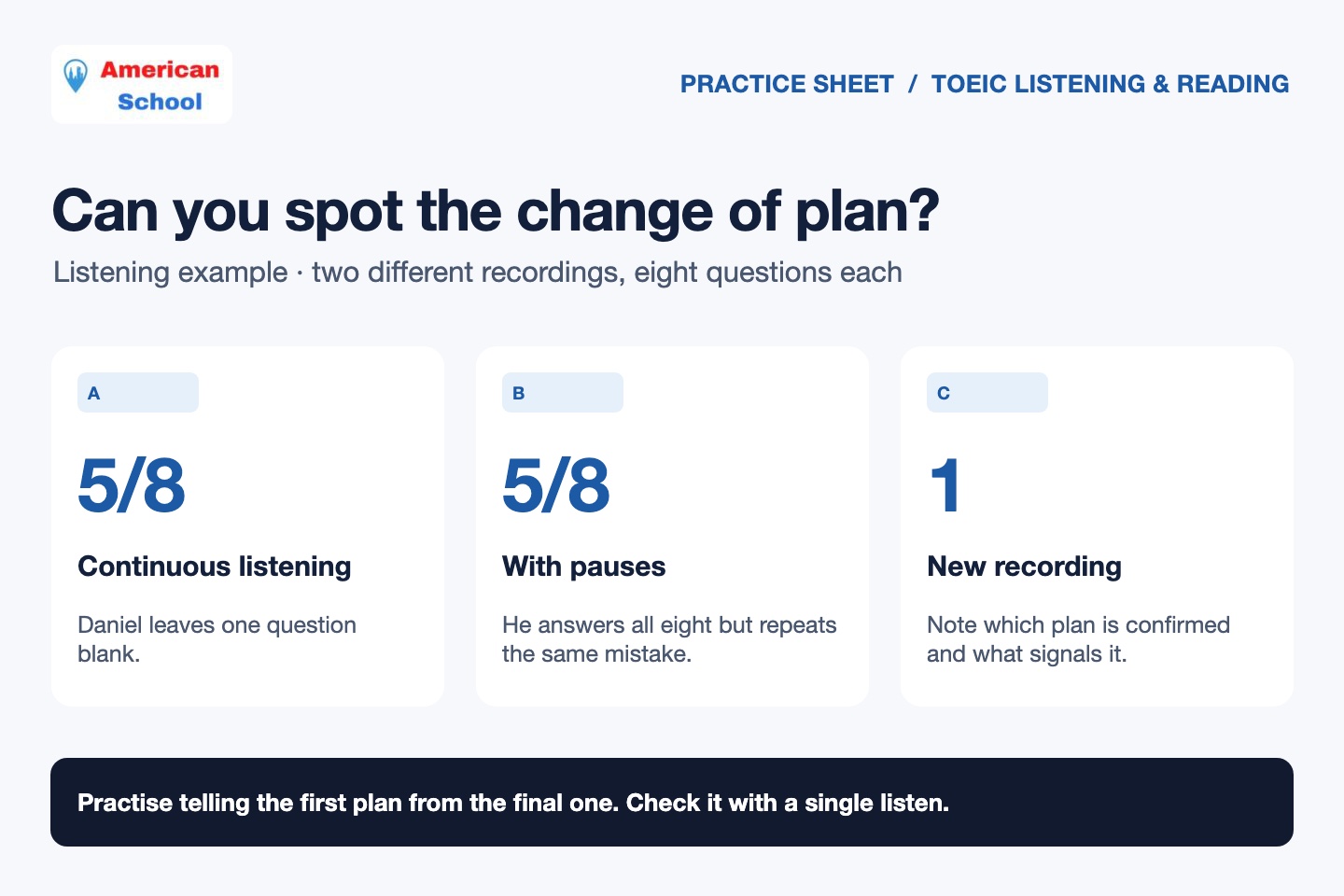
| Daniel, Listening | 5 correct, 2 wrong, 1 blank | 5 correct, 3 wrong, 0 blank | Even with pauses, he keeps confusing the first plan with the final one. |
Alba needs to locate information before rereading
In session A, Alba spends much of her time confirming an answer she had already justified, and leaves the last two questions blank. In the untimed block she reaches the end and marks the details she would have missed under the clock. Her plan is a specific reading rule: before rereading the whole document, find the line that could answer the question, and allow a second read only if the evidence is still unclear.
Try this original example. A notice says: “All delivery requests must be submitted by Thursday at 3 p.m.” A later email says: “For Friday deliveries only, please send your request by noon on Wednesday.” If you are asked when to send a request for a Friday delivery, the answer is noon on Wednesday. The clue is “for Friday deliveries only”: once you see it, you can limit your search to the second text. For any other delivery, go back to the general notice. Before checking the key, try to say in your own words which request each instruction covers.
Daniel needs to follow what was planned and what was confirmed
Daniel answers all eight questions when he can pause, but his score stays at five because he treats the first option he hears as final. He decides to practise the difference between an earlier plan and the action that is confirmed. With new audio, he writes two columns: what they intended to do, and what they will finally do and why, if the audio says.
An original script might say: “We were going to brief the drivers in the loading bay. The forklift inspection will run late, so we’ll meet upstairs instead.” Asked where the meeting will take place, the answer is upstairs: “were going to” introduces the old plan and “instead” signals the alternative. Another recording may use a different signal. Daniel can ask someone to read an equivalent script at natural speed and then explain the change of plan in his own words. To check his progress, he repeats the test with a new recording and a single continuous listen.
Decide what to practise and how you will check it
If removing the time limit cuts your blanks and you find the evidence easily, try a small pacing change. In Reading, set a checkpoint at the end of the first set of texts. In Listening, practise moving on to the next question when the clip ends, even with a doubt left. Write down the result you expect, for example “I want to reach the last question and keep my session A accuracy”, then test it on new material under session A conditions.
If a mistake repeats even with extra time, choose a comprehension task that reproduces the difficulty: compare two messages about an exception, summarise who has to do what, or pull the most recent instruction out of two documents. In Listening, listen first, put the idea into your own words, and only then check the transcript. Once you can explain it, repeat with new material.
Both problems can exist at the same time. Reaching the last question while still confusing deadlines doesn’t cancel the pacing improvement; it gives you two separate goals. Test one change at a time. If you change the time budget, learn new vocabulary and pick shorter material in the same session, your total may rise and you still won’t know what to repeat.
Copy this log sheet for your two sessions
Pace and comprehension log. Use one sheet per section.
| Session and condition | Material and question type | Correct / wrong / blank | Evidence, cause and next step |
|---|---|---|---|
| A · Under pressure | ___ | ___ / ___ / ___ | ___ |
| B · With extra time | ___ | ___ / ___ / ___ | ___ |
| Check · New practice | ___ | ___ / ___ / ___ | ___ |
Add a line for the conditions: “I used the same device, the material was new, and the only difference was ___.” Add a second line for your decision: “Next practice I will ___ and I’ll check whether ___.” If the difference was small, repeat the pair with other material. You can swap the order of the sessions in that new pair, again checking answers only at the end, to see whether getting used to session B affected the result.
FAQ: time and comprehension on the TOEIC
Can I use the transcript in the second Listening session?
Keep it for the review if you want to know what a pause adds. The transcript changes the task because it lets you read the information. Once both attempts are done, use it to pinpoint which word, link or change of intention explains a repeated mistake.
Can an eight-question block estimate my TOEIC score?
Use it to compare your practice and choose what to train. ETS reports official results as scaled scores and adjusts for differences between test forms. On this sheet, correct answers and blanks are observations about two short sets. (Source: ETS, how TOEIC Listening and Reading scores are interpreted.)
What if I only have time for one session?
Do session A and note the details of your doubts before you look at the answers. When you can continue, set aside an equivalent set you haven’t seen. If you worked on session A’s mistakes in between, note it: you’ll get a progress comparison now and another chance to isolate the effect of time later.
Still deciding which certificate fits your job or studies? Compare the options in the American School course catalog.







Responses