
Are you ready for IELTS Academic? Compare two practice tests


American School · Online prep · IELTS Academic
In short: compare two different practice tests taken under similar conditions, and check the minimum your program sets for each skill. Your overall band can sit at 7.0 while Writing stays at 6.0, and that gap changes what you should do before the exam. If you are preparing with the American School online IELTS course, bring your results to your next session.
Imagine you have six weeks to submit an English score. Your first practice test gives you 7.0 overall, and your program asks for exactly 7.0, with 6.5 in each skill. That sounds encouraging until you open the breakdown: Writing is 6.0. You take another test and get 7.0 overall again. The question is still open: has the skill that could stop you meeting the requirement improved?
This guide helps you answer that with a simple sheet. You will set your target, prepare two comparable practice tests and decide whether you have enough evidence to choose a date, need to check one skill, or should change this week’s work. The cases are invented; swap their numbers for yours.
Start with what your program requires
Find the requirement for your specific program, intake and academic year. Copy the accepted test version, the overall band and the minimum for each skill, if there is one. Note the deadline for submitting your score too: it tells you when to take your second practice test and how much margin you have between the exam and the admissions process.
For example, the University of Oxford publishes, for its standard graduate level, IELTS Academic 7.0 overall with 6.5 in each component; its higher level has other minimums. Use it as an example of how to read a requirements table, then find the row for your own program. (Source: University of Oxford, graduate English language requirements.)
The overall IELTS band is calculated from the four skill bands and rounded to the nearest half band, using the rounding rules IELTS explains. You could have 7.5 in Listening, 7.5 in Reading, 6.0 in Writing and 7.0 in Speaking: the average is 7.0, and the Writing requirement in the example is still not met. Record the overall result and each component in separate boxes. (Source: IELTS, official band scale and criteria.)
Write down your target before you start: “My program requires ___ overall, ___ in Listening, ___ in Reading, ___ in Writing and ___ in Speaking. It accepts this test version: ___. I must submit my score by ___.” If the institution sets no minimum for a skill, mark that box “no published minimum”.
Make your two practice tests comparable
Choose two different sets of IELTS Academic practice material in the current format, and keep the second one unopened until test day. If you recognise a text or already know what happens in a recording, note it on your sheet and replace that section with new material before using it to make a decision. The official sample questions show how each task is presented. (Source: IELTS, Academic sample questions.)
Get close to your real test conditions. IELTS publishes about 30 minutes for Listening, 60 for Reading, 60 for Writing and 11–14 for Speaking. If you’ll write by hand because you chose the paper test where it’s available, use paper for both practice tests, and reproduce the way you’ll answer the rest of the exam. (Source: IELTS, official Academic test format.)
- Set the rules. Keep to the time for each section, play the audio once and leave out aids such as dictionaries, translation and spell-checkers. To simulate a long session, do Listening, Reading and Writing back to back. For Speaking, ask someone to put the questions to you and add follow-up questions.
- Keep what you did. Save your Listening and Reading scores, your full Writing responses and, with the other person’s permission, your Speaking recording. If there’s an interruption or you change how you mark, note it next to the date.
- Keep the marking comparable. Record raw scores and estimated bands separately. In Listening and Reading, the conversion from correct answers to band can vary slightly by test version. For Writing and Speaking, try to have the same person review both attempts against the official criteria. If you have a self-assessment or an automatic estimate, note who or what produced it.
If you can only complete one section a day, that practice still shows changes by skill; record the results as separate blocks. If you want to see how the fatigue of a long session affects your Writing, schedule at least one attempt that reproduces the full Listening, Reading and Writing sequence.
Compare the minimum for each skill, test by test
Start with the skill below the requirement. Then check whether the pattern repeats and what made it change. To illustrate, here are two fictional candidates who score 7.0 overall in both practice tests. Both need 7.0 overall and 6.5 per skill.
Practice bands in two comparable IELTS Academic tests
| Case | Test | Listening | Reading | Writing | Speaking | Overall |
|---|---|---|---|---|---|---|
| Alex | A | 7.5 | 7.5 | 6.0 | 7.0 | 7.0 |
| Alex | B | 7.5 | 7.0 | 6.0 | 7.5 | 7.0 |
| Noor | A | 7.5 | 7.0 | 6.5 | 7.0 | 7.0 |
| Noor | B | 7.0 | 7.5 | 6.5 | 7.0 | 7.0 |
Alex has two identical overall bands and the same obstacle in Writing. It makes sense for Alex to open both essays, find the feedback point that repeats and practise that part with a new prompt. Noor meets the requirements in both tests, with Writing exactly at the minimum. A second reading of the essays by someone applying the official criteria can add information, especially if the first 6.5 came from automatic marking.
Don’t build a practice band from your best result each day. That combination doesn’t reproduce either session. Keep each practice test as a complete row and compare both against the same reference. If a Writing or Speaking band is missing because nobody estimated it, leave the overall blank and complete the review before using that row as evidence.
Choose: set a date, check a skill or train a cause
Use the three options below as a personal readiness guide. Two results are a small sample; they tell you more when you know how they were obtained and can explain why a skill changed.
- Consider a date. Both full tests meet the overall band and every skill minimum, under similar conditions and with marking you can explain. Check your program’s accepted test version and deadline. If a skill is right at the minimum, find out which task you find hardest before you fix your calendar.
- Check a skill. Only one test meets the minimum, there’s a variation that changes the decision, or one result was marked a different way. First repeat the skill in doubt with new material and ask for comparable marking. If the doubt affects the overall band, measure all four skills together again before drawing conclusions about the full exam.
- Train a cause. The same skill falls short in both tests. Use your next study block for the cause that repeats. Decide how you’ll check the change, and retest that skill with a new task before taking another full practice test.
A Writing 6.0 followed by 6.5, with 6.5 required, falls under “check a skill”. If the second essay got clearer feedback, review both against the same rubric and note the differences you see. If the second topic felt familiar, practise with a question that makes you develop a new idea. That way you can separate what improved in your answer from what made the task easier.
Turn one observation into your next online session
A note like “I need to improve Reading” helps little when you sit down to study. Make it specific with four details: the question you got wrong, the evidence in your answer, a short exercise and a way to check whether the change works. These examples show what the sheet looks like in use.
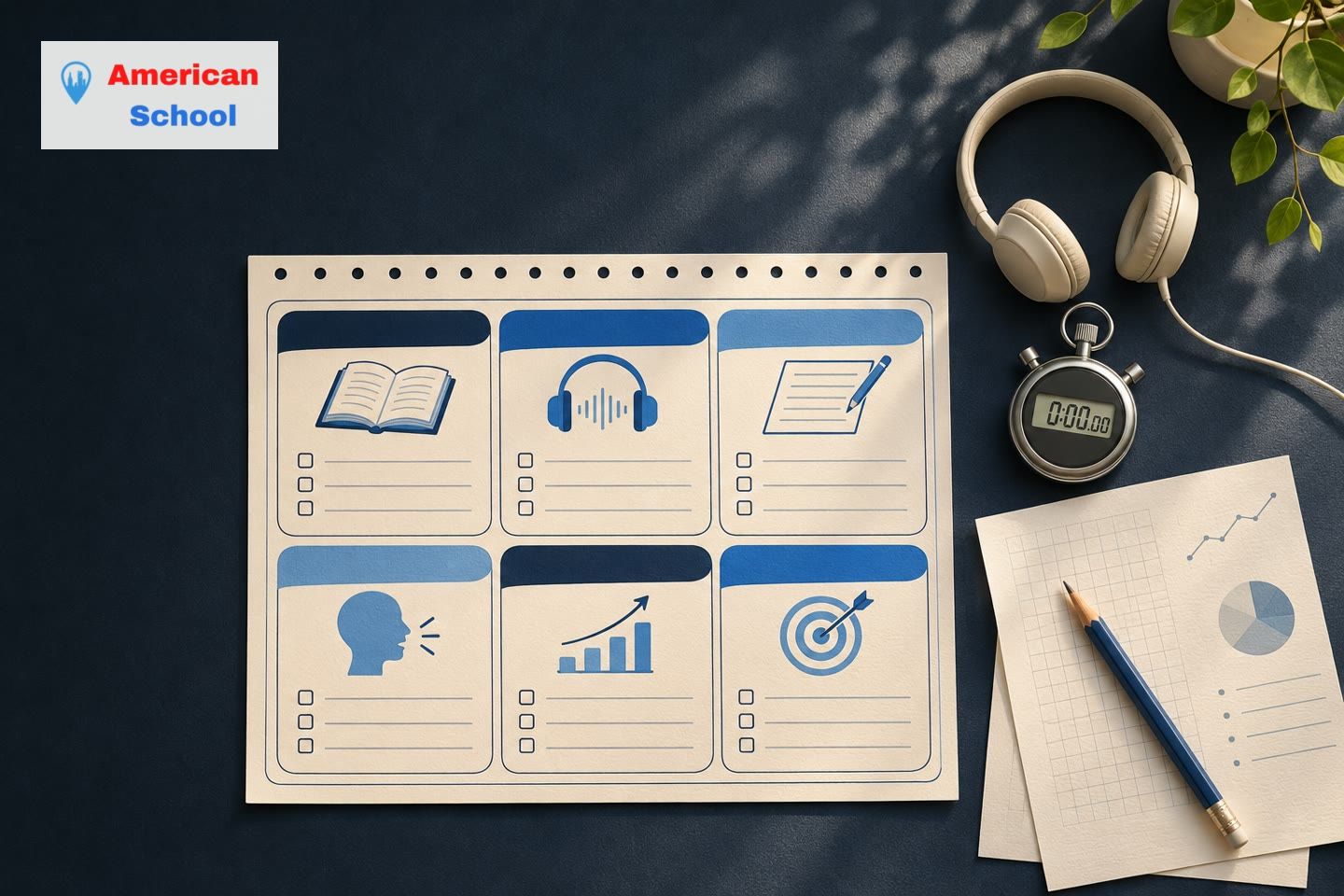
Reading and Listening: find exactly where it went wrong
In Reading, imagine a text that says “The city trialled the service in two districts” and a statement that says “The service was tested across the entire city.” If you got it right after rereading but wrong under time pressure, note the moment you stopped looking for evidence. To practise, take five statements from a new text, underline the word that changes the scope and check whether you can justify each answer with a sentence from the passage.
In Listening, imagine hearing “We were going to meet at eight, but the room won’t be free until half past.” If you wrote eight, note that you kept the first time and missed the correction. In your next practice, listen once and check against the transcript afterwards. Mark where the change is signalled, and check with another recording whether you recognise that signal while writing your answer.
Writing and Speaking: keep a sample and compare
Suppose the feedback on both of Alex’s essays agrees on one point: Alex states a position but moves to the next idea without developing the previous one. With a new question, Alex can write one paragraph with an idea, an explanation and an example that tests it. Then Alex completes a full timed task and asks the reviewer to point out the part that supports the conclusion. That shows whether the paragraph improvement holds up once the clock is back.
In Speaking, your recording may show that you answer with one sentence and wait for the next question. Choose a new topic, answer with a reason and tell a specific story. Ask someone to add a follow-up question you haven’t seen. When you listen back, check whether you expanded your idea when the question changed, and whether the link between your example and your first answer is clear.
Bring one observation from your sheet to each session to choose the skill you need to work on.
Copy this sheet for your two practice tests
Open a spreadsheet or a note and add one row per attempt. If a skill has two types of mistake, keep the details below the table. A stable column is easier to compare than a page of notes a few days later.
Sheet for your targets and practice bands
| Record | Overall | Listening | Reading | Writing | Speaking |
|---|---|---|---|---|---|
| Admission minimum | ___ | ___ | ___ | ___ | ___ |
| Practice test A · date ___ | ___ | ___ | ___ | ___ | ___ |
| Practice test B · date ___ | ___ | ___ | ___ | ___ | ___ |
Below the table, add the material for each test, the format, any interruptions and who marked it. Finish with two sentences: “What I still need to check is ___” and “My next task will be ___ with new material.” If you can answer with something specific, like “develop the main idea of the second paragraph in a timed essay”, you know what to do when you open your next lesson.
FAQ: IELTS Academic practice tests
Is 7.0 in two practice tests enough if my university asks for 7.0?
First check whether the requirement includes minimums per skill. If it asks for 6.5 in each and your Writing is 6.0, the overall practice band alone leaves that minimum unmet. A 7.0 in two practice tests is a sign of readiness if conditions and marking are comparable. To prove the requirement, follow the institution’s instructions for your official result.
Can I use an IELTS General Training practice test?
If you need IELTS Academic, use the Academic Reading and Writing. Listening and Speaking are the same in Academic and General Training. To compare all four bands as a set, choose two tests with the Academic tasks.
Do I have to retake the whole practice test if one skill falls short?
To check whether an exercise fixed a specific problem, start with that skill, using new material and the same marking method. When you want to check your overall band and the effect of pace or fatigue, take a full practice test again. That way each test answers a different question.
Keep your sheet and start your next session with a decision. If you are still comparing which exam to prepare for, browse the American School online course catalog.








Responses