
Running out of time on GRE Quant? Try this pacing test


American School · Online prep · GRE Quantitative Reasoning
In short: solve two short blocks of similar difficulty, one timed and one with no countdown. Your correct answers, the questions you left blank and the exact step where you got stuck will tell you what your next study session should focus on.
On the last question of the block you know exactly what to calculate. Ten seconds left. You type half the answer and time runs out. When you check, two earlier answers are wrong too. Writing “I’m slow at Quant” leaves you with a vague instruction for tomorrow. Maybe you spent too long on one question, maybe you misread a number, or maybe you need to review the concept behind all three mistakes. The three look alike in the final count, and each needs a different kind of practice.
This exercise separates those possibilities with two eight-question blocks. In one, you stop when time is up. In the other, you work without a limit and record how hard each answer was to reach. The blocks use different problems. Comparing them lets you choose one change, test it on new material and see whether it helps. The method is for guiding your preparation at home; the numbers are practice measures, not GRE scores.
Set up two comparable blocks
The current GRE General Test has two Quantitative Reasoning sections: the first has 12 questions in 21 minutes and the second has 15 questions in 26 minutes. Within a section you can skip questions, mark them to come back to, and change answers while time remains. There is also a basic on-screen calculator. For this exercise, 14 minutes for eight questions is close to the first section’s average. It is a training limit for the whole block, and you can spread it unevenly. (Source: ETS, GRE General Test structure and timing.)
Choose two sets from a source you know, or one that labels content and difficulty. If you mix sources, first compare the length of the questions, the answer format and the amount of calculation. As a starting point, include two arithmetic, two algebra, two geometry and two data analysis questions in each set. If percentages are your concern, swap one pair for two percentage problems in both blocks. Match the format where you can: a numeric entry question, where you type the answer, compares better with another numeric entry than with a multiple-choice question whose options help you narrow things down. (Source: ETS, Quantitative Reasoning content areas and sample questions.)
If one block has two questions about a table, give the other a table with a similar amount of data and two questions as well, so the time spent reading graphs is spread the same way. If one set is all short questions and the other has several long word problems, a difference in minutes may come from the material. Note that before blaming a skill.
Keep the solutions out of sight. Keep your computer, calculator, aids and study place as similar as possible. Set aside a third short set, unopened, to check whatever you decide to change. You can build the blocks from material you already have or from the lessons and exercises in the American School online GRE course.
Record what happens under each condition
- Block A, 14 minutes. Start with whichever question you like. If you skip one, mark its number and write two or three words on what stopped you, for example “can’t find the base” or “long calculation”. Stop answering when time is up. Count the blanks, and separate last-second answers chosen by elimination from those you could justify.
- Block B, no countdown. Use the parallel set. Put the clock out of sight if checking it makes you rush. Note the total time at the end, and where you reread, drew a diagram or switched method. If you run out of reasonable ways to solve a question, note how far you got and move on. Use the same aids as in A.
- Check both afterwards. Use the key and keep your scratch work. Link each result to a step you can see: “I took 20% of 80 when the question asked for the percentage of 100” tells you far more than “calculation error”. Add up correct, wrong and blank answers: the three counts should total eight per block.
An answer you got right by elimination counts as correct if it matches the key, but add a mark to remember how you reached it. If you had plenty of time in B and still relied on elimination, that answer needs a second look. If you solved a question in A but forgot to enter it, note that as an incident: the useful data is the answer actually recorded when time stopped.
Before drawing conclusions, ask what changed besides the time. Noise, a more familiar set, or seeing a solution between attempts can explain part of the difference. If something like that happened, keep your notes and repeat the comparison with new material and better conditions.
The same timed score can have different causes
Two sample logs. Figures are correct, wrong and blank answers out of eight.
| Student | A, timed | B, untimed | What stands out |
|---|---|---|---|
| Inés | 5 correct, 1 wrong, 2 blank | 7 correct, 1 wrong, 0 blank | One question swallowed several minutes in A. |
| Omar | 5 correct, 2 wrong, 1 blank | 5 correct, 3 wrong, 0 blank | He used the wrong percentage base in both blocks. |
Inés tries a rule for leaving a question and coming back
In A, Inés spends more than three minutes on a geometry question. Her diagram is right, but she tries several operations without knowing which will get her closer. Two questions are still unread when time runs out. In B she finishes the block and solves a parallel geometry problem on her own once she organises the data. The most promising change for her is a planned second pass: in the next block, when about a minute goes by without a useful step on paper, she will mark the question and move on, jotting down the idea she already has so she can pick it up quickly.
The rule is tested on a real problem. Imagine a rectangular box measuring 5 by 4 by 3, and you’re asked how much its volume increases if only the height changes from 3 to 6. You can calculate 60 and 120, a difference of 60. A shorter route uses the fact that the base is 20 and the height grows by 3, so the increase is 20 × 3 = 60. If your first pass only left the note “base = 20”, that note is your way back in. On a problem that stays closed after several tries, the same mark frees you to earn points elsewhere.
Omar finds a mix-up with the percentage base
Omar answers all eight questions in B and still gets five right. His scratch work shows the same step in two percentage problems: he applies the increase to the starting value even when it should apply to a value that has already changed. Practising with fewer seconds per question would only reinforce a procedure that is still muddled. For his next session he picks four short exercises and writes, under each percentage, the amount it applies to.
For example, a pass costing 80 drops by 25% and then rises by 25%. After the discount it costs 60. The rise is calculated on 60, so it adds 15 and the price ends at 75. Omar had ended at 80 because he applied the second change to the original price. To check he has the distinction, he can solve it with other numbers and change the order of the steps, then explain in one sentence which amount each change comes from. If a question asks for the change compared with the original price, he uses the starting value for that final comparison.
Choose one change and measure whether it works
If the main difference is blanks, try a first-pass rule. You can mark a question when you can’t find a first step, when you spot a calculation you could postpone, or when you still need to confirm a detail. Choose only one of those triggers. If the rule makes you skip questions you had nearly solved, describe them on your sheet, adjust the trigger next session and see which questions you recover on the second pass.
If a concept error repeats in both conditions, prepare two pairs of problems. In each pair, change one feature that forces you to tell the procedures apart: one exercise asks for a total, the next for a difference. Write the operation before using the calculator, and add a line saying what it represents. Once you can explain the step with new numbers, put a limit back on a small set and check whether your reasoning holds.
If you solved correctly but entered the wrong result, practise finishing. Read the last sentence of the question, underline what it asks for, and check what you typed in the box. For numeric entry, note whether the answer is a value, a percentage or a fraction. This routine costs a few seconds; test it on a short block to see how long it takes and how many mistakes it saves.
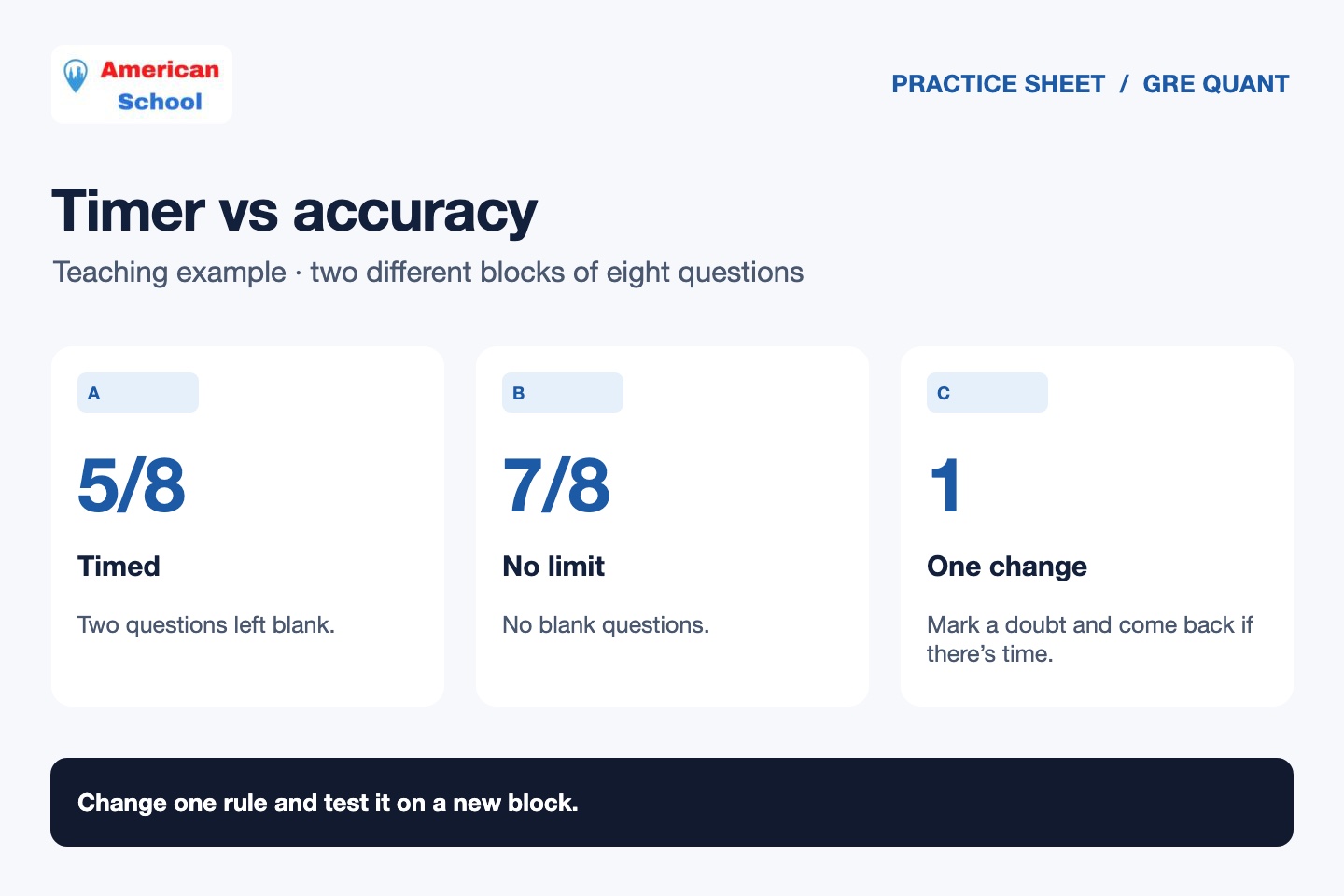
To check the change, use the third set with the same limit as A if it has eight questions. Before you start, write down the rule and what you expect to see. Inés can check whether her blanks drop without losing correct answers. Omar can check whether he uses the right base on percentage problems even if his total barely moves. If the check set is shorter, compare patterns rather than raw totals. The next full comparison will give you more evidence than a single case.
Log sheet for your next practice
Copy one row per block. In the cause column, write the evidence from your scratch work, even when the result seems obvious. If something different happened in A and B, add both observations in separate rows below.
Pacing and accuracy log.
| Block | Date and material | Time and condition | Correct / wrong / blank | Where I got stuck |
|---|---|---|---|---|
| A | ___ | 14 min | ___ / ___ / ___ | ___ |
| B | ___ | No limit, took ___ | ___ / ___ / ___ | ___ |
| Check | ___ | ___ | ___ / ___ / ___ | ___ |
Finish the sheet with two sentences you can test: “If ___ happens, I will ___” and “I’ll know it helps when I see ___”. After a few days, repeat the exercise with another topic to find out whether the change works for just one type of problem or for a mix closer to the real test.
FAQ: timing on GRE Quant
Can I use the same eight questions in both blocks?
Use different questions for the comparison. If you remember an answer, a shortcut or where a number was, you may solve faster just from familiarity. Keeping the first set to review your reasoning is still good practice. To see whether a solution transfers, find a parallel problem with different numbers, wording or unknown.
What if I score higher without a limit but still miss one topic?
Record both signals: time may be causing blanks, and a specific concept may still need work. To read the next session clearly, choose one change. You could review the topic first and check it with four equivalent problems, then see what happens to your blanks when you change your first-pass rule.
Can I convert my eight correct answers into a GRE score?
Use the numbers to compare your own practice. The official Quantitative Reasoning score takes into account your answers across both Quant sections and their difficulty, using ETS’s own procedure. Your short block tells you something else: what you do when you have time and what you do when you have to budget it. (Source: ETS, how GRE scores are calculated.)
If your program accepts several exams and you want to see what prep is available before your next step, browse the American School online course catalog.








Responses