
IELTS Reading summary completion: a method and two worked exercises

American School · IELTS Academic
In short: in Summary Completion questions, every answer has to fit the gap, keep the meaning of the passage and follow the task instruction. Practise both versions with original texts and learn to spot when one extra word changes the answer.
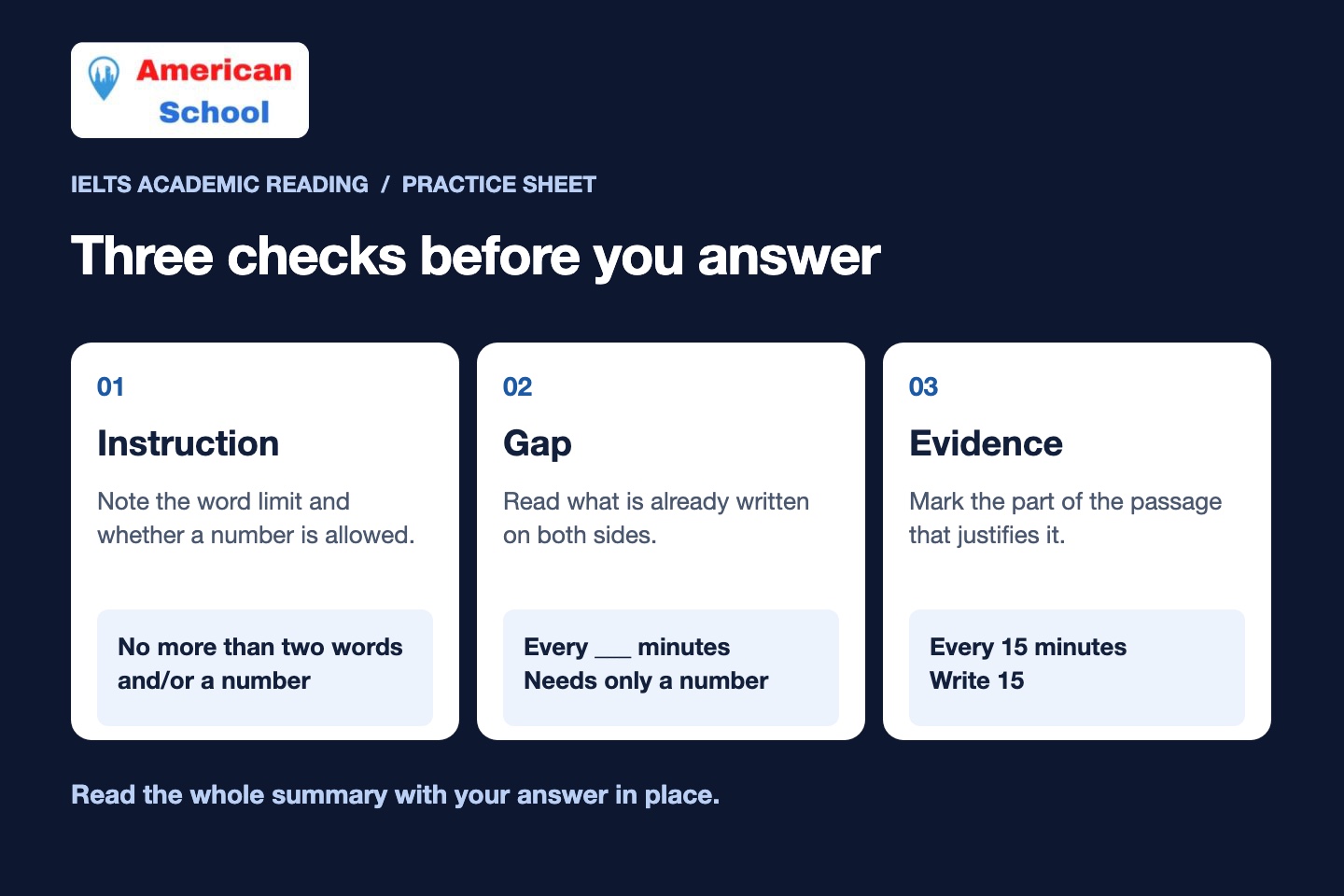
Imagine the passage says “every 15 minutes” and the summary asks you to complete “every ___ minutes”. You’ve found the number and the unit, but if you copy 15 minutes, the sentence will read “every 15 minutes minutes”. The answer for that gap is 15. It’s a small detail, and it shows why you should reread the summary with your answer in place.
If you are studying on your own, treat this guide as a short session. Do each exercise before opening the solution, note the words in the passage that justify each choice, and mark any answer you chose on instinct. That record tells you whether you need to work on locating information, recognising paraphrase or following the format.
What a summary with gaps asks you to do in IELTS Academic
IELTS describes two versions of this question type. In one, you choose words from the passage and copy them within the stated limit. In the other, you pick options from a list. The task can also appear as notes, a table or a flow chart; only the layout of the gaps changes. Either way, you have to link a specific part of the passage to the missing information. (Source: IELTS, official Academic Reading format.)
The summary usually covers one part of the passage. To find it, look for two clues that appear together, such as a place and a procedure, or an object and the result of using it. The gaps tend to cluster in the same stretch, although IELTS warns that answers may not appear in the same order as the questions. If an answer seems to be missing, check the paragraph before jumping to the end.
What to check in each version
| If the task gives you | What you note | Final check |
|---|---|---|
| An instruction with a word limit | The exact words from the passage that complete the gap. | Count only what you write, and check spelling. |
| A list of options | The letter or form the instruction asks for. | Confirm the option expresses the passage’s idea and fits the sentence. |
A four-step method for every gap
1. Read the instruction before looking for answers
Find the word limit and check whether a number is allowed. “NO MORE THAN TWO WORDS AND/OR A NUMBER” sets two limits: up to two words, plus a number if needed. If one word does the job, write just that word. IELTS counts a hyphenated word as one, so low-cost mesh is two words. Keep the hyphen the passage uses.
With a list, read the instruction to the end to see how to record your choice. A letter saves time if that is what’s asked. If you practise on paper, write the word in your notes too: it makes it easier to recognise which option you picked when you review.
2. Decide what kind of answer fits
Read the whole sentence, including what comes after the gap. In “a ___”, the article is already there and the gap probably needs a singular noun, perhaps with a modifier. In “more ___ after the revision”, you probably need an adjective. In “every ___ minutes”, the gap asks for a quantity. This prediction cuts down the words worth considering.
It also helps to identify the relationship the sentence asks for. “By reducing ___” asks what decreased. “Because of ___” introduces a cause. “Rather than ___” makes you find the alternative the sentence rules out. When two words sit close together in the passage, that relationship usually separates the answer from the distractor.
3. Mark one sentence that justifies your choice
Look for a match in meaning. A passage may say that staff used everyday vocabulary, while the summary describes the labels as more accessible. When you choose from a list, both expressions can stand for the same idea. When you copy from the text, the same match leads you to the exact words to transfer.
If you underline a whole paragraph, it’s hard to review your decision. Mark the verb and its object, or two short fragments if the meaning is split across sentences. In the label example, linking rewrote and everyday vocabulary is enough. If you’re still unsure what changed, check what the staff kept in the same sentence.
4. Insert the answer and check for anything extra
Go back to the summary and read it with your answer in place. Check number, articles, spelling and length. If the passage says “a layer of coarse sand” and the gap asks what was placed under the soil, try coarse sand: it keeps the precision of the passage and stays within the limit. The full phrase adds details the gap can do without.
Exercise 1. Complete the summary with words from the passage
This original text describes a fictional study of rain gardens. First read the five gaps and decide, for each one, whether you are looking for an object, a frequency, a material or a way of doing something. Use no more than two words and/or a number for each answer.
At the beginning of the monitoring period, volunteers placed a sensor at the inlet of each rain garden. It took a reading every 15 minutes, and the team wrote down each period of heavy rain separately. A layer of coarse sand lay beneath the planting soil. Its purpose was to slow the flow of water before it entered a buried pipe.
At the surface, the team installed a low-cost mesh to keep larger leaves out of the inlet. Although the mesh trapped most leaves, it did not remove fine sediment. Once a week, the volunteers cleared the mesh by hand. For the first month, the site had a second monitoring device by a nearby path. It recorded air temperature and was outside the main comparison.
Summary. Each garden had (1) _____ at its inlet. This device recorded data every (2) _____. Beneath the planting soil, the researchers placed (3) _____ to slow the movement of water. Larger leaves were intercepted by a (4) _____. Volunteers cleaned this barrier (5) _____ rather than using a machine.
Explained answers, exercise 1
| Gap | Answer | Why |
|---|---|---|
| 1 | a sensor | The first paragraph places this device at the inlet of each garden. The summary sentence needs the article before the singular noun. |
| 2 | 15 minutes | The summary gives every and leaves the whole frequency blank. The number and unit fit the instruction. The heavy rain was recorded separately. |
| 3 | coarse sand | Beneath the planting soil locates the material. The next sentence explains that its job was to slow the water. |
| 4 | low-cost mesh | The mesh caught the larger leaves. The article a is already in the summary. The hyphenated low-cost counts as one word. |
| 5 | by hand | The passage gives a frequency and a way of cleaning. The mention of a machine in the summary shows that the method is what matters here. |
Now try a variation on gap 2. If the sentence were “This device recorded data every ___ minutes”, the answer would shrink to 15. And if the summary said “Each garden had a ___ at its inlet”, gap 1 would take sensor. Say both substitutions out loud to get used to reading the edges of the gap. The passage is the same in each version; only the part you have to write changes.
Exercise 2. Complete the summary with options from a list
This second original text describes a fictional trial at a museum. Write the letter of each option. Where grammar allows several words in a gap, find a sentence in the passage that rules out the others. Pay special attention to what the team says in its final report.
At a local museum, a team wanted to improve the way visitors examined old maps. For repeated public use, the museum provided reproductions at long tables. Its original maps remained in controlled storage. The paper used for the reproductions had a matte surface. It reduced glare from the lamps, which helped visitors notice thin pencil lines.
Before the pilot, several labels described the maps in technical terms. Staff rewrote these labels using everyday vocabulary, but they retained the historical dates. The longest labels were moved to a side panel. At the end of the pilot, the team collected comments from a voluntary sample. Its report cautioned that these comments could describe experiences, but could not establish the effect of the changes on attendance.
Summary. At the tables, visitors worked with (1) _____. The paper’s matte surface made the fine lines easier to see by reducing (2) _____. The labels became more (3) _____ after staff revised the language, although the dates stayed the same. The report treated visitor comments as (4) _____ evidence, since it could not use them to measure the effect on attendance.
Options. A accessible · B glare · C storage · D original · E descriptive · F reproductions · G technical · H attendance · I conclusive
Explained answers, exercise 2
| Gap | Answer | Why |
|---|---|---|
| 1 | F · reproductions | The reproductions were used at the tables. The passage keeps the originals in storage, a different place in the same description. |
| 2 | B · glare | The matte surface reduced glare from the lamps. The fine lines became easier to see as a result. |
| 3 | A · accessible | Rewriting the labels in everyday vocabulary makes them more accessible. Technical describes the wording before the change. |
| 4 | E · descriptive | The comments describe experiences. The report limits their use for measuring attendance, so conclusive would give the comments a strength the report rules out. |
Gap 4 lets you practise a common mistake. Descriptive and conclusive are both adjectives that work before evidence. To choose, read what the comments can do and how far the report’s conclusion goes. If you only found the word attendance, go back to the verb that describes what the comments allow. Grammar narrows the field; the meaning of the passage decides.
Log sheet for checking your next practice
Reuse the same sheet with a new exercise. Two rows per session are enough: one for a wrong answer and one for a right answer you got on instinct. The second row helps you find correct answers that would be hard to repeat. If you can note the evidence for both gaps, tomorrow you’ll have a more useful task than redoing the whole exercise.
Summary Completion answer log
| What to note | Example |
|---|---|
| Instruction and gap | No more than two words and/or a number. Every ___ minutes. |
| What kind of information is missing | A number. The sentence already gives the unit. |
| What the passage says | It took a reading every 15 minutes. |
| What you wrote and what fits | I wrote 15 minutes. The answer that fits is 15. |
| What you’ll check in the next exercise | I’ll read the words after the gap before copying. |
To check whether your fix works, use a different passage from the official materials. Answer once at your own pace and mark the words that justify each answer. In the next exercise, start by applying the action you wrote on your sheet. If your mistakes cluster in list options, spend your review choosing between two grammatically possible options and explaining which sentence tips the balance. (Source: IELTS, official Academic sample tasks with answers.)
If you want online practice to build this question type into your full preparation, see the American School online IELTS course. The American School course catalog also lists the platform’s other exam courses.
FAQ
Can I use a synonym when the instruction asks for words from the passage?
Copy the words from the passage that fit the summary. Use synonyms as clues to find them, because the sentence around the gap usually paraphrases the passage. With a list, choose the option that keeps the meaning even if the wording is different.
What if the phrase I find is longer than the limit?
Check which part of the phrase the gap needs and which details are already in the sentence. In the garden example, coarse sand identifies the material within the limit. If your shorter version loses a necessary detail or becomes ungrammatical, look for another phrase in the passage before deciding.
How can I check an answer without rereading the whole text?
Read the evidence sentence together with the completed gap. If it is clear who did what, when it happened or what effect it had, check the length and move on. If context is missing, read one sentence either side. For many gaps, that small window is enough to see a reference, a cause or a change in meaning.
To practise both the list and copy-the-words formats, see also IDP IELTS’s explanations of Summary Completion.






Responses